
For years, our team wanted to teach machines not just to capture the world, but to see and understand it.
Yet, like much of the computer vision industry, we kept building narrow solutions for individual problems.
First came cloud video recording. Then basic video analytics that could distinguish people and animals from rain, shadows, and moving trees — already a major improvement over traditional motion detection. Later, we built systems for collecting datasets, training specialized models, and recognizing specific situations.
Every solution was useful.
But each could do only what its creators had originally designed it to do.
After years of working with video technology, AI, and computer vision, we began working closely with a security systems integrator. The company installed video systems for businesses whose needs increasingly went far beyond security.
Their customers wanted better visibility into how their physical locations actually operated.
They wanted to monitor cleaning quality across large chains, detect facility and equipment problems, analyze manufacturing processes, identify delays, verify procedures, and understand when something was going wrong.
And increasingly, they wanted more than alerts.
They wanted AI Vision, IoT, and existing business systems to work together so that when something deviated from normal, the right response could start automatically: create a task, notify the right person, escalate an issue, update another system, or activate connected equipment.
We knew how to build these solutions.
The problem was how we had to build them.
We would propose deploying a platform, modifying several modules, collecting and labeling data, training models, integrating external systems, and developing custom interfaces.
It would take months and cost a significant amount of money.
Then, when the customer wanted to change something, the answer was often another development project — and another large bill.
At the time, this seemed reasonable to us. The work required experienced engineers, researchers, data scientists, and developers.
Then one day, after another customer was shocked by the cost of a proposed solution, the integrator’s director said something that changed how we looked at the problem:
“You are all very smart people. You have degrees, and you use the right words: AI, computer vision, machine learning. But from where I stand, none of this looks particularly intelligent.
If this were truly AI, I should be able to install a camera and explain, in normal human language, what I want the system to watch, when I need its help, and how I want the results presented.
Instead, you disappear to develop something for several months and return with a very large invoice.”
We reacted like mature, reasonable adults.
We were offended.
But after thinking about it, we realized he was largely right.
The market was full of computer vision products, but most solved a limited set of tasks defined in advance by their creators. Customers and integrators repeatedly ran into those boundaries.
This is one reason why most cameras still do little more than record. They watch facilities and business processes every day, but rarely turn what they see into useful operational data — let alone trigger the work required when something goes wrong.
Meanwhile, businesses hear constantly about what AI should make possible. But when they try to apply it to their own physical operations, the reality is often much less flexible: either the technology has to be rebuilt around the business, or the business has to change around the technology.
We believed there should be another way.
A Platform That Adapts to the Business

We decided to build the product we wished we had been able to offer that integrator and its customers.
A video intelligence platform that could connect easily to existing or new cameras, provide the core capabilities of a modern video management system, and let users describe in normal language what they wanted the system to observe.
The platform would turn those observations into usable data, combine them with information from IoT and business systems, and react when something important happened.
The result might be a dashboard, a notification, a task, an embedded interface, an update to another system, or an action sent to connected equipment.
The important part was that every new requirement should not become another custom software project.
Instead of forcing the customer into a predefined use case, the platform should adapt to the way the business already works.
That was the beginning of Vmatica.
Making Flexible AI Practical
Turning that idea into a reliable product required much more than connecting an AI model to a camera.
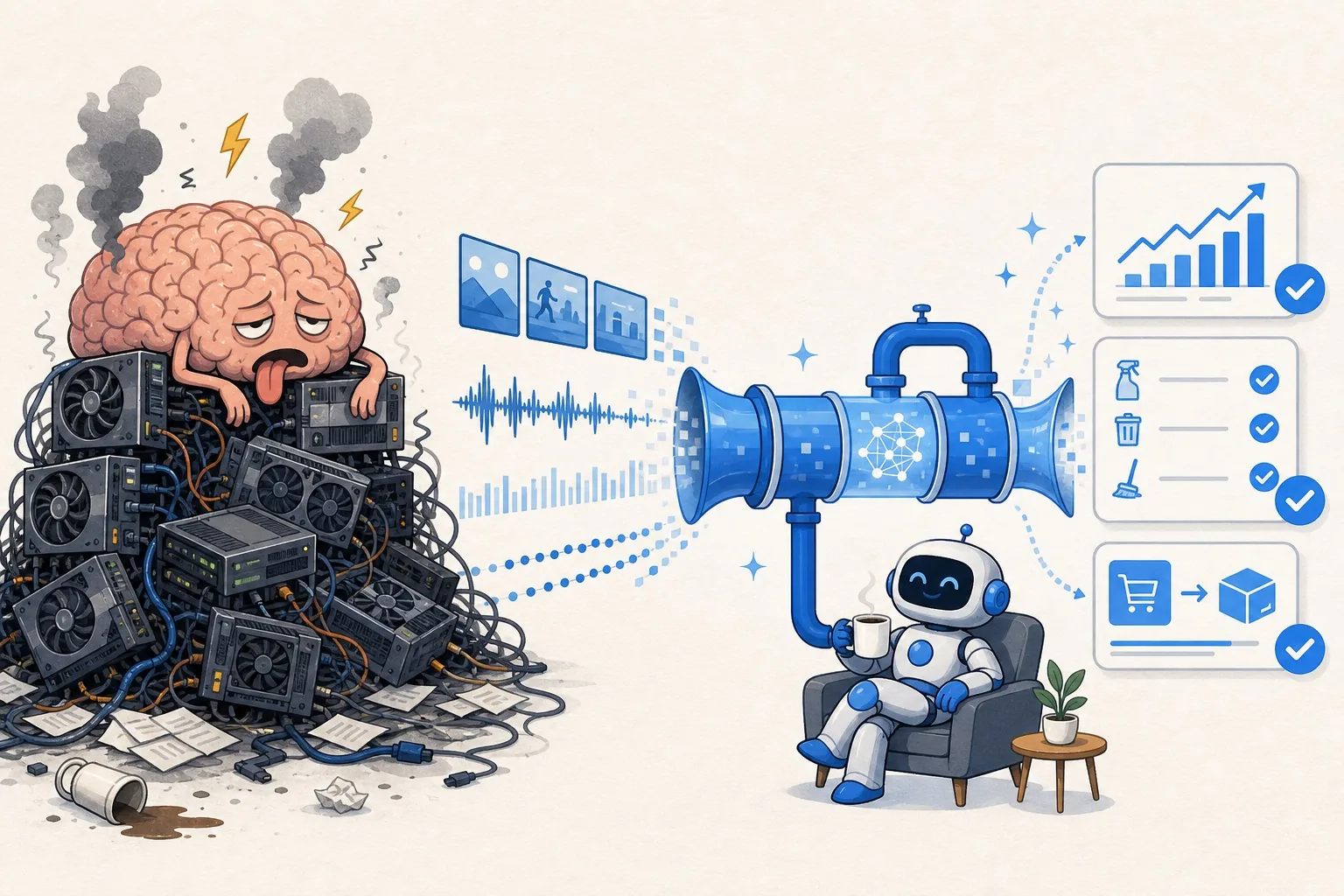
A platform flexible enough to handle many different tasks can easily become too slow, too expensive, or too fragile for continuous real-world use.
Running large general-purpose models across every frame from every camera would consume enormous amounts of computing power, most of it unnecessarily.
So flexibility also had to be efficient.
We researched ways to represent events, actions, objects, and their relationships over time. We developed technology that turns flexible video-analysis logic into lightweight, high-performance processing pipelines.
Vmatica adapts computation to the task and the scene, running only the models and operations that are actually needed.
It can focus on relevant cameras, zones, objects, and moments; change how often different stages are executed; and activate more expensive models only when earlier stages indicate that they are useful.
We worked to eliminate unnecessary calculations, repeated processing, and redundant memory transfers while taking advantage of hardware-accelerated preprocessing and inference.
These details sound technical because they are. But they determine whether AI Vision becomes an everyday operational tool or remains an impressive but expensive demonstration.
Performance was only one part of the problem.
Real physical locations are not controlled laboratories.
Networks become unstable. Cameras disconnect. Video arrives in different formats and resolutions. Hardware resources are limited. Scenes change. Models fail. Components need updates while the rest of the system keeps running.
We isolated models and processing components so failures and updates would not bring down an entire deployment.
We also spent a surprising amount of time on something that sounds trivial: opening video quickly.
So we optimized the whole path — camera connectivity, stream handling, buffering, edge-to-cloud communication, delivery, and playback.
The goal was infrastructure reliable enough to run continuously across real locations, but flexible enough to adapt to the needs of an individual business.
This did not always fit the familiar startup advice:
“If you are not embarrassed by the first version of your product, you launched too late.”
But we were not trying to build another narrow AI feature.
We wanted a foundation reliable enough for continuous physical operations, efficient enough to remain affordable at scale, and flexible enough that a new business requirement would not automatically mean months of custom development.
The complexity had to stay inside the platform — not become the customer’s problem.
From Vision Agents to an AI Brain
Even that was not enough.
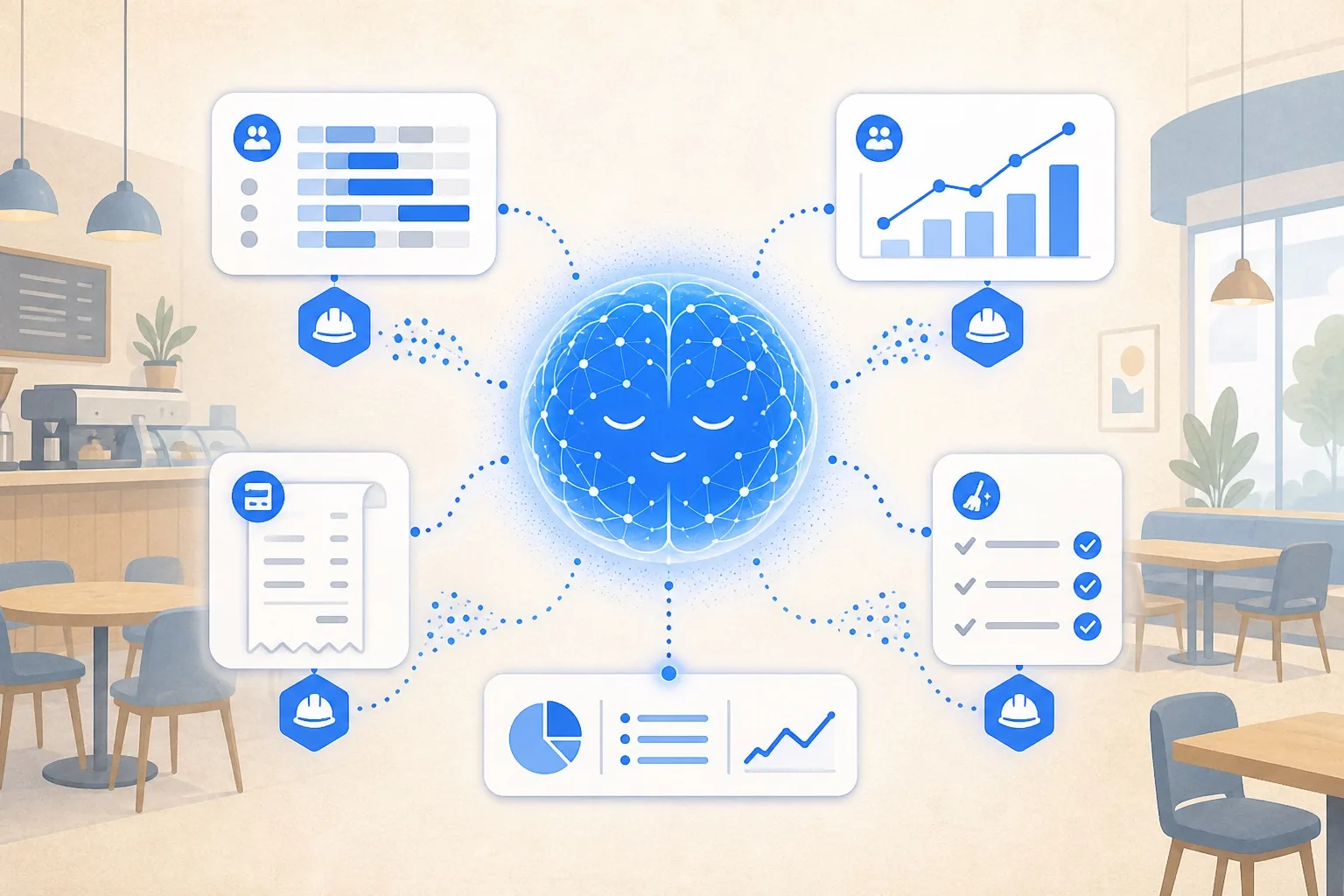
Once Vision Agents begin observing operations, they produce something cameras rarely created before: structured, contextual data about what happens across locations and over time.
A camera stops being only a source of footage.
It becomes a source of operational knowledge.
Individual Vision Agents can watch specific processes, detect events, collect measurements, identify deviations, and trigger actions.
But many of the most useful answers cannot be found inside one camera or one event.
They come from connections.
A delay may be related to staffing levels.
A quality problem may occur only during particular shifts.
A queue may depend not only on customer volume, but also on equipment status, order complexity, layout, or the way people move through the location.
A facility issue may become visible only when video observations are combined with sensor readings, maintenance history, schedules, or previous incidents.
That led us to the next part of the Vmatica vision: the AI Brain.
The AI Brain combines information produced by Vision Agents with data from POS, ERP, IoT, facility systems, and other business sources.
Reporting what happened is useful.
Understanding why it happened is much more valuable.
The goal is to find relationships that are difficult to see from individual events, identify where processes can improve, and help businesses make better operational decisions.
Over time, this can go further: helping coordinate processes involving people, software, machines, and robots, and learning from the outcomes of previous actions.
The Road Ahead
We have already built much of the foundation we once imagined. Ideas that began as research notes, diagrams, and prototypes are now working inside Vmatica.
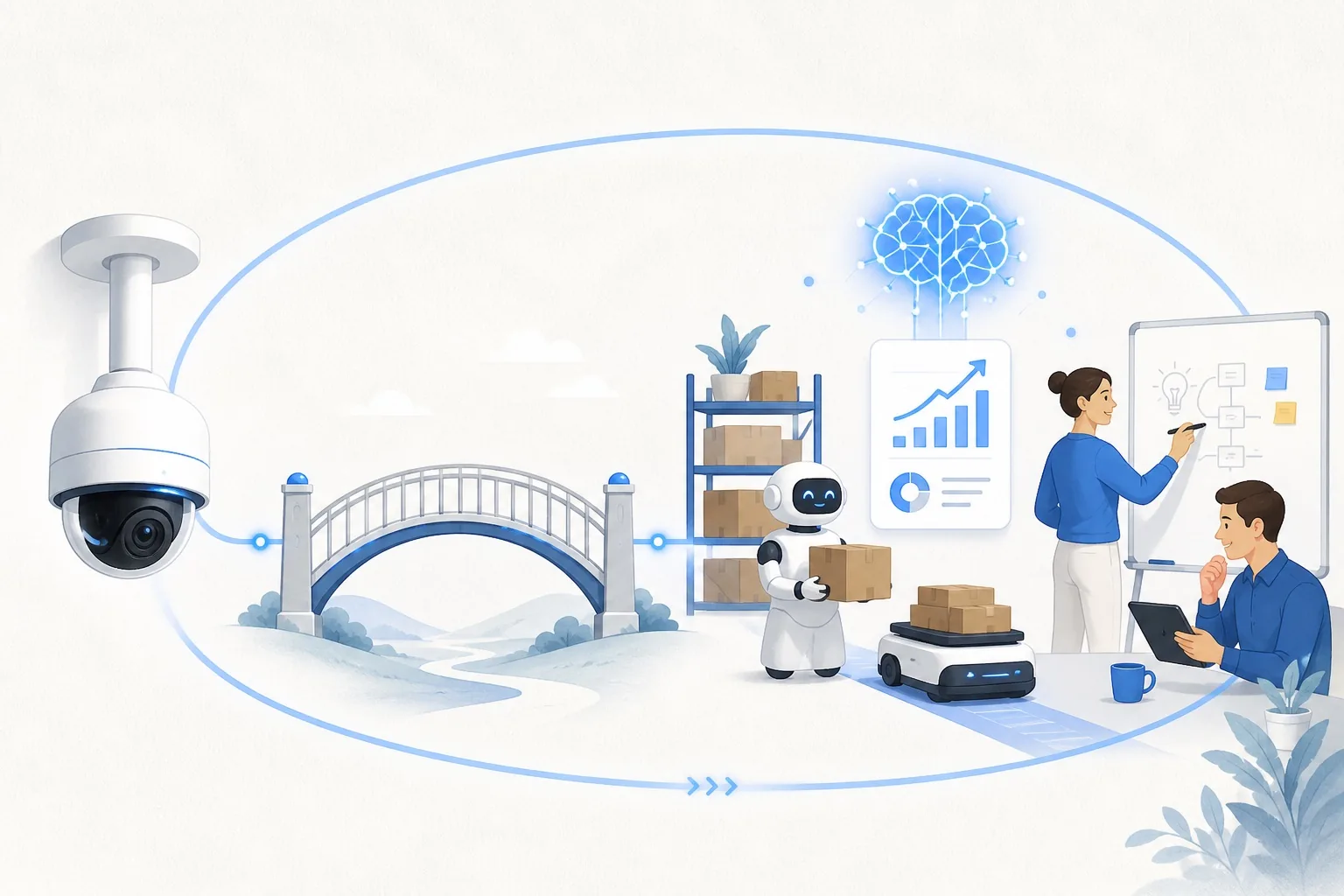
Cameras are no longer limited to recording security events. Vision Agents turn what they observe into structured data, and the AI Brain connects that data with the rest of the business to help explain what is happening and why.
When something requires attention, the system can increasingly help start the next step instead of simply reporting the problem.
We believe cameras, sensors, AI models, business systems, people, machines, and eventually robots will become parts of the same operational loop: observe what happens, understand what matters, act when necessary, measure the result, and improve over time.
One day, systems like Vmatica may coordinate much more of the repetitive work that keeps physical businesses running, while people spend more of their time on judgment, creativity, communication, and care.
But that future starts with something much simpler:
Giving businesses a practical way to tell machines what matters.
We spent years teaching machines to see.
Now we are building the bridge between seeing and doing — so intelligence can enter the physical world, handle more of the routine, and help people focus on what humans do best.
Vlad Cohen
Founder, Vmatica